Computational Astronomy as Code
Open-science computational astronomy built to be reproduced. We pursue discovery-oriented research on DESI, Rubin/LSST, and COSMOS-Web surveys. The infrastructure, methodology, governance, and datasets are all published so others can use or extend them.
RadioAstronomy.io is an independent computational astronomy research lab. We run a portfolio of discovery-oriented projects on modern spectroscopic surveys, balancing work that produces community-valuable datasets with higher-risk searches for previously unknown phenomena. Everything we build, including the infrastructure it runs on, is documented and published so other institutions and researchers can verify our work, extend it, or deploy the same approach themselves.
What drives our work
Science with Purpose
Projects are selected for concrete community output: peer-reviewed papers, Value-Added Catalogs, or reusable datasets. We prioritize research addressing fundamental astrophysical questions with clear impact potential.
Discovery Hunters
Portfolio approach balancing proven methods at unprecedented scale with higher-risk searches for phenomena not accounted for in current models. Even failed high-risk projects produce methodology improvements and side-data that serve the community.
Open Science, Open IT
Infrastructure design, analysis code, database schemas, security baselines, and operational practices are all published. That includes the governance work adopted for the org itself: model cards for the AI systems in use, NIST AI RMF alignment, and CIS Controls v8.1 as a target. Governance templates are maintained publicly in the NIST AI RMF Cookbook for other small research orgs to adapt.
By the numbers
Galaxy rows
Void classifications
DESI DR1 Value-Added Catalogs
Compute nodes
Featured research

DESI Cosmic Void Galaxies
ActiveComparing void and wall galaxies to disentangle nature versus nurture in galaxy quenching using 6.4M DESI DR1 galaxies and 10,752 void classifications.
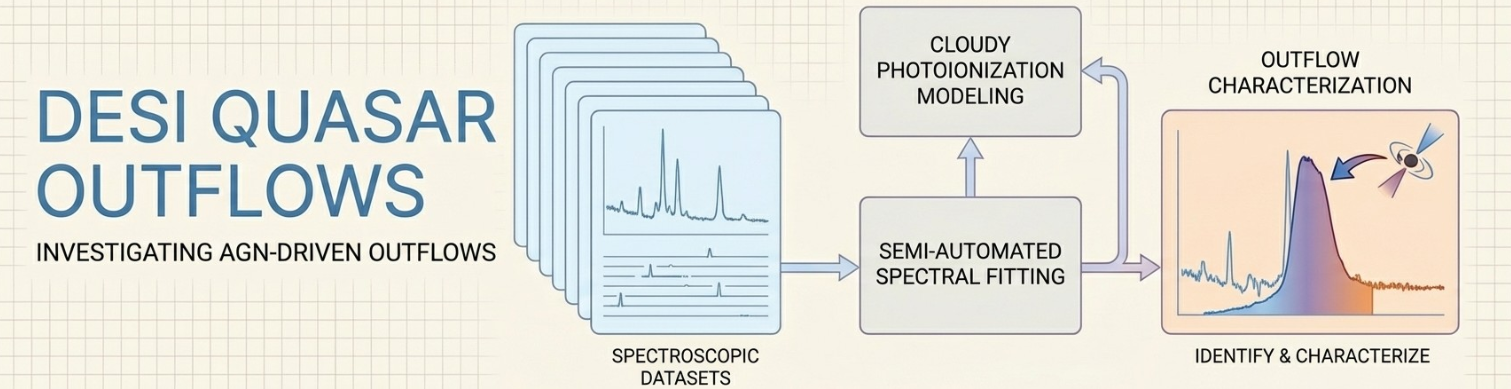
DESI Quasar Outflows
PlannedMeasuring outflow distances, mass outflow rates, and kinetic luminosities for the first comprehensive catalog of quasar outflow energetics.
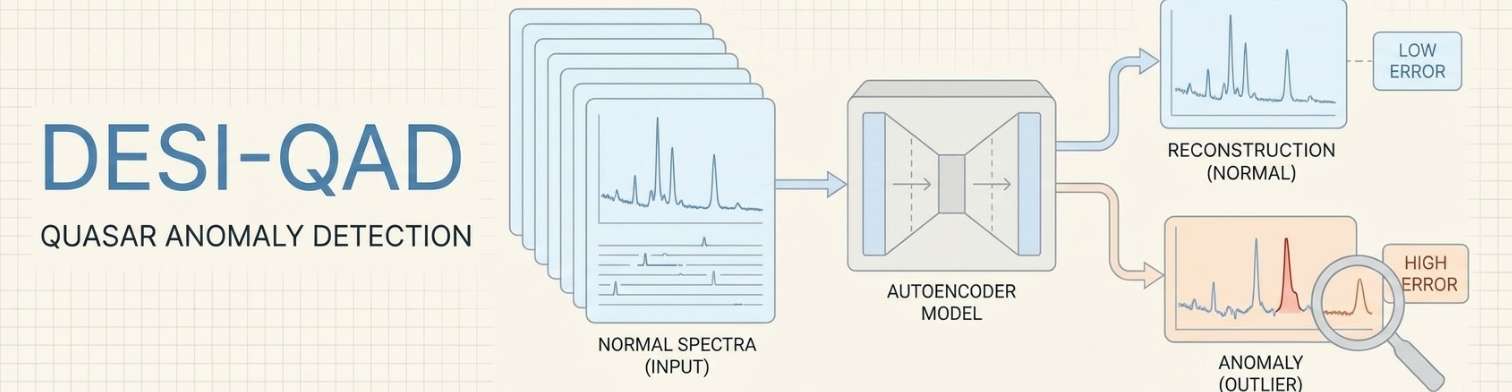
DESI QSO Anomaly Detection
PlannedSystematic outlier detection revealing rare objects that may represent unusual accretion physics, rare evolutionary phases, or new source types.
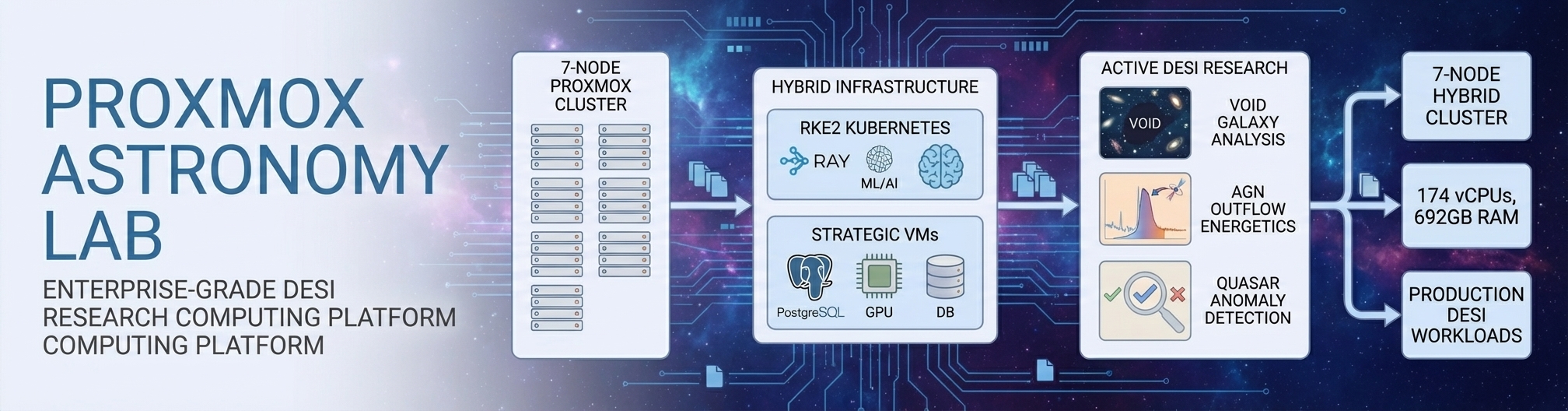
Proxmox Astronomy Lab
Production144 cores, 704 GB RAM, 26 TB NVMe, and RTX A4000 GPU compute. Enterprise-grade infrastructure for independent astronomical research.